Hull cleaning at port or anchorage
Portable in-water hull cleaning for vessels that cannot afford downtime.
Green hull cleaning starts with controlled waste capture. NSADA's on-site filtration system captures debris removed during hull cleaning and returns clean water. The vessel uses an existing waiting window instead of creating a new stop.
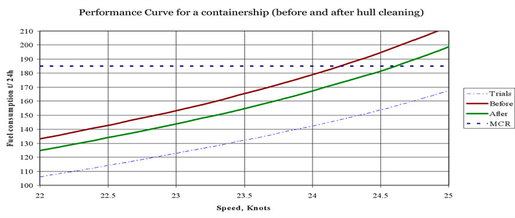
Performance curve for containerships (before and after hull cleaning)
Hull resistance
As fouling increases surface roughness, frictional resistance rises. The vessel then needs more thrust and more shaft power to hold the same speed through the water.
What the curve shows
After hull cleaning, the performance curve shifts in the operator's favor. For the same power input, the vessel can achieve higher speed. If the speed target is held constant, required power drops.
Commercial effect
That is why hull cleaning is not only a maintenance action. It is a direct efficiency action that affects fuel burn, schedule margin and how long the vessel can stay commercially active before resistance growth starts eroding performance.
Hydrodynamic loss starts earlier than most operators want.
Heavy growth is not the first problem. The penalty often starts with slime. Resistance rises, power demand climbs and the vessel needs more energy to hold the same speed.
That is why operators act early. Push harder to keep schedule and fuel burn rises. Hold power steady and speed margin disappears.
Fuel drift is only the first symptom.
For a skipper or superintendent, fuel drift is only the first warning. Fouling also makes speed response less predictable and erodes schedule margin.
That matters because underwater resistance is one of the few avoidable losses that compounds every day.
The smart maintenance move is early cleaning, not late recovery.
Early cleaning is usually the better commercial decision. It stops resistance growth before it becomes a larger fuel problem and a larger planning problem.
That is why repeated hull cleaning works as a maintenance strategy. It gives fleet teams a planned intervention instead of a reactive one.
Use the waiting window instead of creating a new downtime window.
Most commercial vessels are too expensive to stop for avoidable reasons. Crew cost keeps running. Charter pressure keeps running. The question is whether the job can be done inside a window that already exists.
This is where NSADA's portable setup matters. The equipment is brought to the vessel, so the job fits the operating schedule instead of creating a new downtime event.

Biofouling Stages
Early action costs less
The chart shows a simple operational truth: early fouling is easier and cheaper to manage than advanced fouling.
Technical penalty grows in stages
As roughness and growth become more established, drag and resistance increase. The hull moves further away from design condition and recovery becomes a larger maintenance task.
Commercial pressure follows
When fouling is allowed to progress, the technical penalty becomes a planning and cost problem as well. That is why repeated cleaning makes more sense than waiting for heavy growth.
One mobilization should solve more than one underwater problem.
If a vessel already has an in-water service window, that window should be used properly. Hull cleaning can be combined with propeller cleaning, underwater inspections, sea chest cleaning and other targeted underwater work in the same mobilization.
That means fewer separate call-outs, less coordination and more work completed before the vessel sails.
Why this model suits fleet operators.
Fleet operators need actions that are repeatable, schedulable and easy to align with trading patterns. A portable hull-cleaning model supports exactly that.
That is why repeated service agreements make sense. They reduce last-minute procurement and keep hull performance management closer to a controlled process.
Book hull cleaning before resistance growth turns into avoidable cost.
If fuel behavior is drifting, speed response is softening or the vessel already has a waiting window, that is the time to act. Contact NSADA to plan hull cleaning at port or anchorage and combine it with propeller work, inspection or sea chest cleaning in the same stop.