Propeller cleaning at port or anchorage
Restore smoother blade surfaces without creating a new service stop.
A fouled propeller turns engine power into avoidable loss. NSADA cleans the propeller where the vessel is already waiting, so thrust efficiency can be recovered without creating a separate off-hire event. Once divers are already in place, it also makes sense to review the full underwater scope and complete other needed work in the same service window.
Propeller resistance
Blade roughness changes the flow
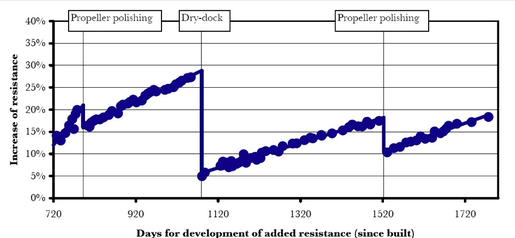
Marine growth and surface roughness disturb water flow over the blade surface. As roughness increases, hydrodynamic losses increase and more shaft power is needed to produce the same useful thrust.
Why operators notice it quickly
The propeller is a direct power-to-thrust component. When blade condition degrades, the penalty is often seen quickly as softer response, higher load or poorer fuel efficiency for the same operating profile.
Commercial meaning
That is why propeller cleaning is not cosmetic work. It is a propulsion-efficiency action that can help recover thrust performance before avoidable power demand turns into avoidable fuel cost.
Restore thrust before the propeller starts wasting more power.
The propeller does not need heavy growth before performance starts slipping. Once the blade surface becomes rougher, more power is needed to produce the same useful thrust.
That is why operators act early, before the penalty spreads across voyages, fuel figures and schedule response.
If response is softer, the propeller may already be costing you money.
For a skipper, chief engineer or superintendent, the warning signs are practical: softer acceleration, higher load, less efficient response and more power used to maintain the same result.
That is avoidable loss on one of the most important efficiency surfaces below the waterline.
Clean the propeller inside the waiting window, not in a new downtime window.
Most vessels cannot justify a separate stop just to recover propeller performance. NSADA mobilizes to the port or anchorage where the vessel is already waiting, so the job fits the schedule that already exists.
That reduces disruption and makes the service easier to approve quickly.
One underwater service window should solve more than one problem.
Propeller cleaning is often most valuable when it is combined with hull cleaning, underwater inspections or other targeted in-water work in the same mobilization.
Once divers are already in place, the efficient decision is often to complete the wider underwater service scope at the same time. That means fewer separate call-outs, less coordination and more technical work completed before sailing.
Repeated cleaning helps keep propulsion performance under control.
Fleet teams need interventions that are easy to repeat and easy to plan. Repeated propeller cleaning helps keep propulsion performance closer to controlled condition instead of waiting for losses to build.
That supports cleaner reporting, better planning and fewer reactive decisions.
Book propeller cleaning before avoidable load becomes avoidable cost.
If the vessel is already waiting, if propulsion response is softer than it should be, or if the service window can be combined with hull or inspection work, this is the right time to act.